SHE THOUGHT SHE WOULD WIN PLENTY OF SUPPORT — BUT ONE UNEXPECTED REASON SENT EVERYTHING IN THE COMPLETE OPPOSITE DIRECTION! Today, Kemi Badenoch announced she would scrap inheritance tax on family homes, saying that if she takes power, no family property would be hit by inheritance tax, and that parents would be allowed to pass on £1 million tax-free. It looked like a windfall from nowhere for the middle class, and it turned Kemi Badenoch into a bold, uncompromising “icon.” But everything seems to have gone off course because of ONE SINGLE REASON that cost Badenoch her support…
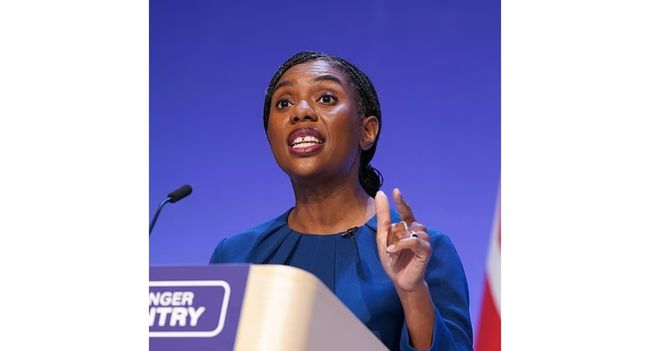

Kemi Badenoch has accused Labour of pushing Britain into a damaging cycle of higher taxes, weaker growth and fewer jobs as she used her Conservative Party conference speech to set out a new economic dividing line with the government.
Speaking in Birmingham, the Conservative leader argued that Labour’s tax policies were making it more expensive for businesses to employ people while placing growing pressure on households and entrepreneurs.
Her address formed the centrepiece of a conference increasingly focused on tax, employment and economic growth, with Badenoch presenting the Conservatives as the party of lower taxation and a smaller state.
One of the most prominent proposals unveiled by the Tories is a plan to reduce employer National Insurance contributions for younger workers.
Under the proposal, the employer NIC rate would be cut by half for workers aged between 21 and 24.
The Conservatives say the policy would cost around £2.3 billion and is designed to encourage businesses to recruit young people at a time when concerns are growing about graduate employment and opportunities for people entering the workforce.
Badenoch has argued that employers are currently being discouraged from taking on additional staff because of the growing cost of employment.
She has repeatedly blamed Labour’s tax decisions for what she describes as a weakening jobs market.
The Conservatives hope the National Insurance proposal will allow them to contrast their approach with Labour’s, particularly after increases in employer costs became a major point of political contention.
The party says reducing those costs for younger employees would make businesses more willing to hire graduates and other workers at the beginning of their careers.
Badenoch used her conference speech to broaden that argument, accusing Labour of creating what she called a “tax doom loop.”
Her central claim was that higher taxes suppress investment and growth, which in turn reduces government revenues and creates pressure for further tax rises.
She argued that Britain must instead pursue policies that encourage businesses to expand, employ more people and invest in the economy.
Her speech also included a major announcement on inheritance tax.
Badenoch said a future Conservative government would remove family homes from inheritance tax calculations.
Couples would also be able to pass an additional £1 million to their children or other beneficiaries without paying inheritance tax.
The Conservatives say the changes would significantly reduce the number of estates subject to the tax.
Badenoch presented the proposal as a matter of fairness, arguing that people who spend their lives working, saving and buying a home should be able to pass more of their wealth to their families.
She also made clear that her longer-term ambition would be to abolish inheritance tax entirely.
The policy has immediately attracted criticism from Labour and trade unions, which argue that the largest gains would go to wealthier households.
Critics say relatively few estates currently pay inheritance tax and have questioned whether billions of pounds in tax cuts should be prioritised at a time when public services remain under financial strain.
The Conservatives insist the package can be funded through substantial reductions in government spending.
Badenoch has said her party has identified tens of billions of pounds in potential savings, including changes to welfare spending and the size and scope of the state.
Her economic message is part of a broader attempt to redefine the Conservative Party after its heavy general election defeat in 2024.
At the Birmingham conference, Badenoch has sought to convince members that the party has developed a clearer identity and is ready to return to government.
She has repeatedly argued that previous Conservative governments allowed spending, regulation and taxation to rise too far.
Her leadership has therefore increasingly focused on deregulation, lower taxes and reductions in state expenditure.
The party has also proposed major changes to planning and environmental regulation, arguing that excessive bureaucracy is slowing housebuilding and infrastructure development.
Conservative proposals include scrapping the Environment Agency and Natural England in their current forms, replacing existing planning obligations for developers and reducing environmental requirements attached to new housing projects.
The party says these measures would make development cheaper and faster, while opponents have warned they could weaken environmental protections.
Badenoch also used her speech to attack Labour’s broader economic record.
She accused the government of pursuing policies that increase the cost of doing business and said Britain needed a stronger focus on wealth creation rather than redistribution.
Her remarks came as the Conservatives seek to regain credibility on economic issues after losing power.
The party is also trying to recover voters who have moved to Reform UK while retaining support among traditional Conservative voters in southern England.
Badenoch rejected suggestions that the Conservatives should enter into an electoral agreement with Reform.
She said there would be no pact and argued that the Conservative Party must win voters back by presenting a credible programme of its own.
Her conference speech also included criticism of Labour politicians including Prime Minister Keir Starmer and Andy Burnham, while she dismissed the idea of reopening Britain’s Brexit settlement as a major political priority.
She described renewed arguments over Brexit as a distraction from the economic and structural problems facing the country.
The Conservatives’ plan to cut employer National Insurance for young workers was announced ahead of Badenoch’s keynote address and became one of the conference’s major economic policies.
Supporters say it could help tackle youth unemployment and give businesses a financial incentive to recruit workers in their early twenties.
Critics, however, have questioned whether employers would create genuinely new jobs or simply receive a tax reduction for workers they would have hired anyway.
There are also questions over how the policy would be funded alongside the Conservatives’ other tax-cutting commitments.
Badenoch has responded by insisting that spending reductions would come before tax cuts and that the party would not make unfunded promises.

She has sought to distinguish her approach from both Labour and Reform by arguing that economic credibility must remain central to Conservative policy.
The inheritance tax announcement is likely to prove particularly important politically.
The Conservatives believe the issue resonates strongly with homeowners who feel rising property values have pulled ordinary family homes closer to the inheritance tax threshold.
Under Badenoch’s proposal, the family home would be excluded from the tax entirely, while couples could transfer a further £1 million tax-free.
The party estimates that the reform would halve the number of families paying inheritance tax.
Labour and other opponents have challenged that presentation, arguing that the policy would still disproportionately benefit people with substantial assets.

The TUC has also criticised the plan, saying public money would be better spent on services and support for working households.
For Badenoch, the speech was intended to demonstrate that the Conservatives have moved beyond internal arguments and are beginning to develop a coherent programme for the next election.
After a difficult period following the party’s 2024 defeat, her position inside the Conservatives appears to have strengthened.
The party nevertheless continues to face a challenging electoral landscape, with both Labour and Reform competing for voters who previously backed the Conservatives.
Badenoch’s answer is an increasingly clear economic pitch: lower taxes, less regulation, reduced state spending and stronger incentives for businesses to hire and invest.
Whether voters accept that argument will determine whether the Conservatives can turn improved internal unity into an electoral recovery.
For now, Badenoch is framing the battle in stark terms.
Her claim is that Labour’s approach leads to a self-reinforcing cycle of taxation and stagnation, while the Conservatives would attempt to break that cycle by cutting the cost of employment, reducing inheritance taxes and shrinking the role of government.
It is a message she hopes will define the party’s path back to power.