Her Father Sold Her to a Deaf Rancher for $50—Then She Saw Something Moving Inside His Ear
On the eighth night of her marriage, Rosalie Ashford learned that the most frightening thing in Gideon Rook’s house was not the man everyone in town had warned her about.
It was what she saw moving inside his ear.
Only days earlier, Rosalie had arrived at Gideon’s isolated ranch believing her life was effectively over. Her father had accepted fifty dollars in exchange for a marriage arrangement, using his daughter as the final answer to debts he could no longer outrun.
The people of Coldwater offered Rosalie little comfort.
Gideon was thirty-eight, wealthy by local standards and almost completely deaf. He owned cattle, timberland and one of the largest ranches beyond the northern ridge, yet he rarely appeared at church gatherings or social events.
That distance had allowed rumors to grow.
Some called him strange.
Others called him dangerous.
The cruelest referred to him as the “half-mad deaf rancher.”
Rosalie had no way of knowing what was true.
What she did know was that the men in her own family had already shown her exactly what cruelty looked like.
Her father drank heavily and had spent years allowing debts to swallow what remained of the Ashford household. Her brother Merrick was little better. When Rosalie protested the marriage, Merrick told her she should consider herself fortunate.
Fifty dollars, he said, was more than anyone else had offered.
Those words stayed with her.
A wedding without celebration
Snow covered Coldwater on the morning Rosalie married Gideon.
She wore her late mother’s ivory dress, faded with age and carefully repaired around the sleeves. There were no flowers waiting for her. No excited relatives. No whispered promises about happiness.
This was not a wedding built around love.
It was a transaction.
Then Gideon appeared.
He was taller than Rosalie expected, with the weathered appearance of a man who had spent years working outdoors. He spoke very little because he could hear almost nothing and his own speech had become difficult for strangers to understand.
During the brief ceremony, Gideon looked at Rosalie more than he looked at anyone else.
When instructed to kiss his bride, he did not seize her or pull her close.
He barely touched his lips to her cheek.
That small gesture confused her.
Rosalie had spent the previous night preparing herself for the worst. She expected possession. Demands. Perhaps anger if she failed to please him.
Instead, Gideon helped her into the wagon, placed an extra blanket across her knees and drove north without touching her again.
The journey was mostly silent.
Yet silence, Rosalie soon realized, did not always mean hostility.
The first message changed everything
Gideon’s cabin stood among snow-covered pines with a barn and several smaller outbuildings nearby.
Rosalie expected something dark and neglected.
Instead, she found swept wooden floors, stacked firewood and a bed covered with clean quilts. Fresh bread sat beneath a cloth in the kitchen.
Gideon carried her small case into the bedroom.
Then he took out a worn notebook.
His handwriting was firm and surprisingly neat.
The bedroom belongs to you. I’ll sleep beside the fire.
Rosalie read the line again.
She looked toward the bed and then toward him.
Gideon simply waited.
He was giving her a choice.
It was an unfamiliar experience.
Her father had decided where she lived. Her brother had decided what she was worth. The creditors had decided when her family should be frightened.
Now the man who had supposedly purchased her was refusing to behave as though he owned her.
That first night, Rosalie locked the bedroom door.
Gideon did not object.
The next morning, she found him asleep in a chair near the cold fireplace.
A marriage written in pencil
Their early relationship developed through a battered notebook that remained on the kitchen table.
Storm tonight.
Flour is above the stove.
I will repair the north fence.
Do you need anything from town?
The messages were simple, but gradually Rosalie started adding her own.
The roof leaks near the pantry.
You forgot your gloves.
There is stew on the stove.
Soon their conversations grew longer.
Gideon explained that he had lost most of his hearing as a boy after an accident. He remembered pain, blood and weeks of fever afterward. Doctors had examined him, but whatever treatment was available had done little.
By adulthood, he had learned to live in a world built largely around sound without being able to participate in it.
He watched faces.
He noticed movement.
He felt vibrations through floorboards.
And because speaking often attracted mockery, he had learned to say less.
Rosalie began to understand how a quiet man could be transformed by gossip into a frightening one.
People filled silence with whatever story entertained them most.
The detail Rosalie could not ignore
There was, however, something Gideon had not explained.
His right ear still hurt.
The first serious episode happened several days after Rosalie arrived.
She found him near the hearth, one hand gripping the edge of the table and the other pressed against the side of his head.
His face was pale.
Sweat covered his forehead despite the winter cold.
Rosalie rushed toward him.
Gideon waved her away at first, but she refused to leave.
Eventually, he reached for the notebook.
Happens often.
Rosalie frowned.
How often?
He shrugged.
That was not an answer.
Over the next few days, Rosalie began seeing details she had previously missed. Gideon sometimes woke with stains on his pillow. He rubbed his right ear after returning from the cold. On several occasions, he abruptly stopped working and closed his eyes until a wave of pain passed.
One evening, Rosalie pushed the notebook across the table.
How long has your ear hurt?
Gideon looked down.
Since I was a child.
The whole time?
Not every day.
She hesitated before writing again.
Did the doctors know?
His response came slowly.
They said the damage was permanent.
Rosalie stared at the sentence.
That explained his deafness.
It did not explain the continuing pain.
The eighth night
Three nights later, the mystery became impossible to ignore.
They were eating supper when Gideon suddenly jerked sideways.
His chair overturned.
A plate shattered against the floor.
Gideon fell against the table, pressing both hands to his head.
Rosalie had never seen him in such pain.
She hurried to his side, but he could barely focus.
His right ear was red and visibly swollen.
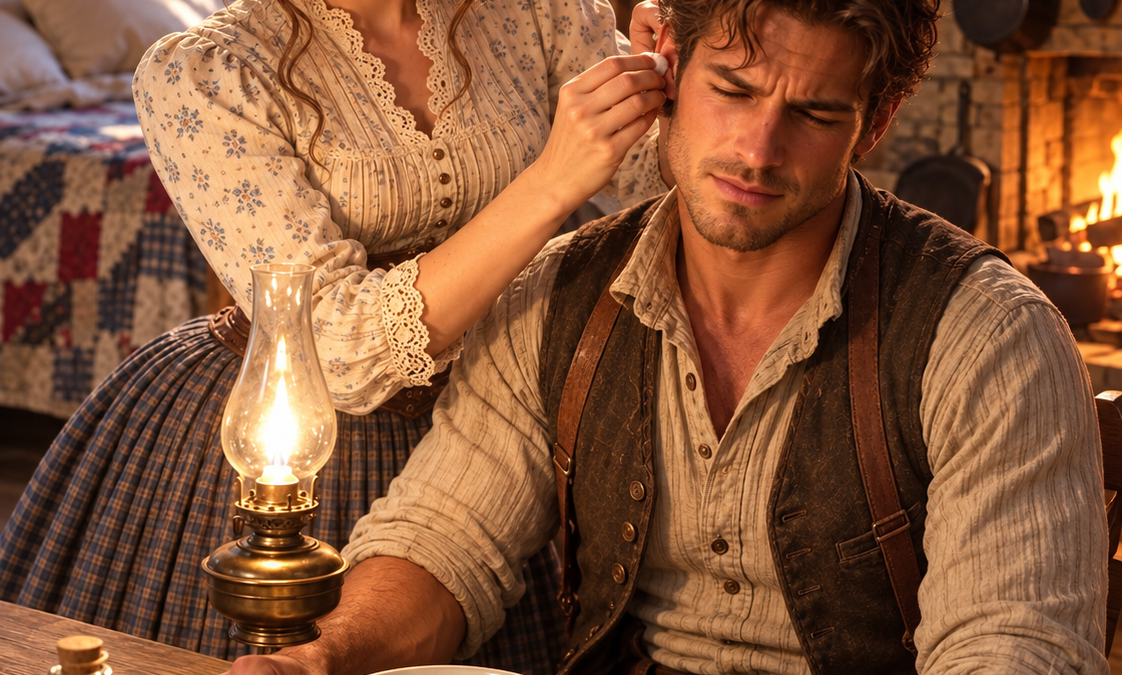
Rosalie brought the oil lamp closer.
At first, all she could see was irritated skin.
Then something changed.
A shadow moved.
Rosalie stopped breathing.
There was something dark inside Gideon’s ear canal.
And it moved again.
She set the lamp down, boiled water and reached automatically for the small pair of sewing tweezers she used for delicate work.
Gideon understood what she intended.
He caught her wrist.
With his other hand, he pulled the notebook toward him.
Dangerous.
Rosalie read the word.
He was right.
Trying to remove something lodged deeply in an ear can cause serious injury, and in real life such a situation requires medical attention rather than improvised treatment.
But in their isolated fictional frontier setting, the nearest physician was hours away through worsening snow, and Gideon’s pain was becoming unbearable.
Rosalie wrote:
Do you trust me?
Gideon looked at her for several seconds.
Then he released her wrist.
What fell into the bowl
Rosalie positioned the lamp as close as she safely could.
She could see the end of a dark object partly concealed by wax and dried material.
She worked slowly.
The first attempt failed.
Gideon’s hand tightened around the edge of the table.
Rosalie stopped immediately.
After allowing him to recover, she tried once more.
This time, the object shifted.
Then it came free.
Something black dropped into the porcelain bowl.
For a moment, neither of them moved.
Then Rosalie saw movement.
A small insect, dark and jointed, crawled weakly from the mass that had been removed.
Rosalie recoiled.
Gideon could not hear the faint scratching against the bowl, but he saw her expression.
His eyes immediately dropped toward it.
The discovery was horrifying, but it did not provide the miraculous explanation Rosalie initially imagined.
The insect could not have lived inside Gideon’s ear since childhood.
More likely, it had entered recently and become trapped around old damaged tissue and hardened debris, making an existing problem dramatically worse.
Gideon’s lifelong deafness remained.
But within minutes, something else changed.
The severe pressure began to ease.
Gideon touched the side of his head cautiously.
Then he looked at Rosalie.
For perhaps the first time since she had met him, there was no tension in his face.
Relief, but not a miracle
The following morning, Rosalie insisted they seek help as soon as the weather allowed.
A physician in the nearest settlement examined Gideon several days later.
His conclusion was less dramatic than the rumors that would eventually spread around Coldwater.
Gideon’s hearing loss appeared to be old and severe, likely connected to childhood injury and subsequent complications. The recently trapped foreign material had caused inflammation and acute pain but had not created decades of deafness.
There was no miraculous restoration of hearing.
Gideon did not suddenly hear Rosalie’s voice.
He did not wake the next morning to birdsong.
What he received was something more modest and more believable: relief from pain that he had been conditioned to endure without complaint.
For Rosalie, that mattered.
She had begun to understand that Gideon had survived years of people assuming that because one problem could not be fixed, none of his suffering deserved further examination.
He had stopped expecting anyone to ask.
Rosalie asked.
Then her family returned
Word traveled quickly through Coldwater.
Within weeks, people who had once treated Gideon like an object of suspicion began inventing exaggerated versions of the story.
Some claimed Rosalie had cured his deafness.
Others said Gideon had nearly died.
Merrick Ashford heard something different.
He heard that his sister’s husband had money.
He arrived at the ranch one afternoon with their father.
Rosalie saw them through the window and immediately felt the old fear return.
Her father did not begin with an apology.
He began with a request.
They needed money.
Again.
Merrick argued that Gideon owed them something because the family had “given” Rosalie to him.
The wording made Gideon’s expression change.
Rosalie saw it before anyone else did.
He reached for the notebook, wrote several words, and handed it directly to her.
What do you want?
Not what did her father want.
Not what did Merrick want.
Not even what Gideon wanted.
What did Rosalie want?
She looked at the two men who had decided her value was fifty dollars.
Then she finally answered for herself.
“I want them to leave.”
Gideon did not threaten them.
He did not need to.
He simply opened the door and pointed toward the road.
Merrick protested.
Rosalie’s father cursed.
Gideon remained completely still.
And Rosalie stood beside him.
Eventually, the two men left.
Fifty dollars returned
Several weeks later, Gideon rode into Coldwater alone.
When he returned, he placed something on the kitchen table in front of Rosalie.
Fifty dollars.
She looked at him, confused.
Then he opened the notebook.
Your father called it payment.
He turned the page.
I never bought you.
Another page.
This is yours.
Rosalie stared at the money.
For several moments, she could not write.
Finally, she took the pencil.
Then why did you agree to marry me?
Gideon read the question and looked toward the fire.
His answer took time.
I was lonely.
Then another sentence.
I knew what people said about me.
And finally:
I thought you might choose to leave once you knew me.
Rosalie felt something tighten in her throat.
The irony was almost painful.
She had arrived believing she had been sold to a monster.
Gideon had welcomed her believing she would eventually discover he was unworthy of being loved.
Both had been shaped by the judgments of other people.
Neither story was true.
The choice that mattered
Rosalie did not suddenly become a different person.
Neither did Gideon.
Their marriage remained quiet.
They still used notebooks.
They still misunderstood one another occasionally.
Gideon remained deaf.
Rosalie continued carrying the emotional scars of a family that had treated her security as something negotiable.
But one fundamental fact had changed.
Rosalie was no longer staying because she had been sold.
She was staying because she chose to.
Months later, the original notebook had nearly run out of pages.
Among weather reports, shopping lists and reminders about cattle were conversations that would have been easy for anyone else to overlook.
Back before dark.
Your hands are cold.
I made bread.
Don’t forget the north gate.
Then, on one page, Gideon had written a question.
Are you happy here?
Rosalie’s response appeared beneath it.
I am safe here.
She had crossed out the sentence.
Underneath, she had written another.
Yes.
For a woman whose wishes had once been valued at less than a family debt, that single word carried extraordinary weight.
The most dramatic moment of Rosalie and Gideon’s story may have happened under the glow of an oil lamp, with a porcelain bowl on the table and something dark moving inside it.
But that was not the real turning point.
The real turning point came when Rosalie recognized the difference between silence and cruelty.
Her family had spoken loudly and hurt her deeply.
Gideon could barely hear, yet he had listened to her choices from the beginning.
And in the end, the man Coldwater feared was not the one who had taken away her freedom.
He was the first one who gave it back.
You Might Also Enjoy


A striking argument from prosecutors has become one of the final talking points in Russell Brand’s high-profile London trial