Janis Joplin Confronted the Hells Angels Who Raided Her Kitchen — They Came Back With 10 Bags of Groceries
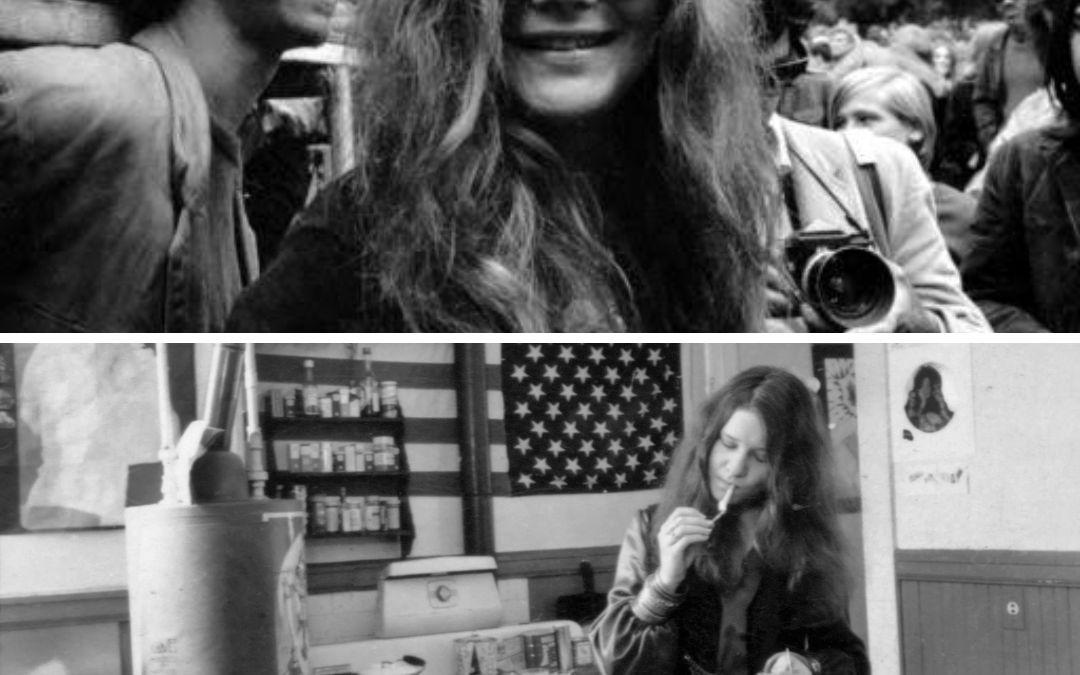
David Niehaus told it in November 2015, after the DOC NYC premiere of Amy Berg’s documentary Janis: Little Girl Blue, on a panel with Berg and Dick Cavett. PBS later cut the same recollection into an American Masters outtake. There is no contemporary newspaper item, no arrest log, and no second witness on the record. What follows stays inside what Niehaus said, and what the Bay Area scene around Janis Joplin makes plausible.
One night in Marin County, in the last year of her life, five Hells Angels were in her living room with the refrigerator open. Her boyfriend would not throw them out. She did. About an hour and a half later they came back in a station wagon with ten bags of groceries, filled the fridge, wiped the counters, and left.
Niehaus’s version, as reported by Vulture on November 16, 2015, is short enough to quote almost whole. They were asleep. Noise in the living room. She told him to go see. He found five Angels, two with guns in their belts, the fridge open and the food out. He went back. She said, “Get rid of those boys, honey.” He said he was not going to try: guns, five of them, and he was “sort of skinny right now.” She went out, called each man by name, and told each of them where he stood. They left. He thought, thank God he had not had to do it. An hour and a half later they returned, not on bikes, in a station wagon, in the middle of the night, with ten bags of groceries. They stocked the refrigerator, cleaned the house, wiped the counters, and left. His closing line was the one the clip was built to carry: “So she had the power. Sometimes she was a little girl and sometimes she was a giant.”
PBS’s write-up of the American Masters extra, posted in May 2016, compresses the same night: armed Hell’s Angels, middle of the night, kitchen raided, commotion, Niehaus unable to move them, Janis telling each of them off, then ten bags of fresh groceries to restock the refrigerator. The network’s headline was “How Janis Made the Hell’s Angels Get Her Groceries,” and the kicker was that she did not even have to ask. A radio retelling the same week added the cleaning detail Niehaus had already given: fridge filled, house cleaned, counters wiped. The numbers do not drift. Five men. Two guns visible. Ten bags. Marin. Night.
That is the whole primary record. Everything else is context.
David Niehaus was not a road manager or a hanger-on from the Haight. He was a schoolteacher, American, from the Cincinnati–Indianapolis orbit, teaching at the American School of Rio de Janeiro when he met her. He had just come back from roughly a year on the Amazon. In February 1970 Janis Joplin flew to Brazil for Carnival, trying to get clear of heroin. She was thrown out of the Copacabana Palace after swimming naked in the pool. She stayed with people in Leblon. On Ipanema beach she walked up to a man who did not know who she was and said something like “Hey, honey.” He teased her that she looked a lot like that singer, Janis Joplin. She liked that he had not clocked her. They stuck. He helped her through withdrawal with methadone she had brought. They left Rio on a motorcycle, crashed into a concrete barrier near Cabo Frio, recovered, and hitchhiked on toward Bahia. She sang in clubs and, by one Brazilian account, in a brothel in Salvador. The military government would not let her play an outdoor show. When she went home, his visa had expired and he could not go with her. She relapsed in Los Angeles. He did get to California later. The Marin night belongs to that later stretch, the months before October 4, 1970, when she died of an accidental heroin overdose in room 105 at the Landmark Motor Hotel in Hollywood, age twenty-seven. A letter from him was in the desk drawer. One published line from it: he missed her, he loved her, Mama, more than she thought.
He told the grocery story forty-five years later, flown in from Hawaii for the documentary panel. Memory at that distance can enlarge a room and round a number. It can also keep a picture that embarrassed the teller, which this one does. He is the man who would not go back out. The anecdote only works if he stays the lesser figure. That is a reason to treat the outline as his honest recollection and the stage business — exact words to each Angel, what was in the bags, whether they were invited or simply walked in — as unknown.
Why were Hells Angels in a Marin living room at all? By 1970 Janis was not a stranger to the San Francisco chapter. The Bay Area clubs and the outlaw clubs had been tangled since the middle of the decade. The Grateful Dead and Jefferson Airplane used Angels for stage security and generator watch, sometimes for a case of beer. Big Brother and the Holding Company’s Cheap Thrills, the 1968 album that made her a national star, carried a small mark in the corner of Robert Crumb’s cover: “Approved by Hell’s Angels Frisco.” Almost no other record got that stamp. She knew chapter figures, including president Ralph “Sonny” Barger, and she had a liaison with Bill “Sweet William” Fritsch, a Diggers-adjacent Angel who moved between the hippie communes and the club. In that world a kitchen raid was not a burglary in the suburban sense. Doors in Marin and the Haight were often unlocked. Food was communal until it wasn’t. Men with colors treated a friend’s house as a place to land. The insult, in Niehaus’s telling, was not that they came. It was that they emptied the fridge while she was asleep and would not hear the skinny boyfriend.
The guns matter, and he put them in the story on purpose. Two in belts, not drawn. In 1970 that was ordinary Angel carriage, not a raid team. It was still enough to end the negotiation he had been sent to conduct. He went back to the bedroom and said so. The useful detail is her answer. She did not ask him to be brave. She took the job. And she did not perform a general scolding. He said she called each of them by name. That is the sentence that makes the night specific. A woman who can name five armed men in her living room is not meeting them for the first time. She is inside the acquaintance. Naming is a form of rank. It says: I know who you are, and you know who I am, and this kitchen is not a clubhouse.
What she said to each of them is not on tape. “Told each one of them where they were at” is Niehaus’s phrase, the 1970s way of saying she read them. The PBS cut calls it telling them off. Either way, they left. He was relieved he had not had to try. An hour and a half is a long gap for a apology run in Marin after midnight. Long enough to find an open market or a brother’s house with food, long enough to borrow a station wagon, long enough for someone in the group to decide that walking out under her mouth was not the last word they wanted attached to their name. They did not come back on the bikes. The wagon is the tell. Ten bags do not ride well on a chopper. They came back as men doing an errand.
The restocking is the part that turned the anecdote into a clip. Ten bags, fridge filled, counters wiped, house cleaned, then gone. Niehaus did not say she ordered the groceries. PBS is explicit that she did not have to ask. The labor was the apology. In club manners, paying back a respected woman in kind — food for food, and a cleaned room so the insult did not sit — was available as a move. It is not a move they made for everyone. It is also not proof they were gentle. The same clubs supplied the security at Altamont on December 6, 1969, where Meredith Hunter was stabbed to death in front of the stage during the Rolling Stones’ set. Janis had played earlier that day, with the Flying Burrito Brothers’ area of the bill, and had left before the killing. The grocery night, if it sits in 1970, sits after Altamont. The men who wiped her counters were not a different species from the men at the speedway. They were men who had decided, in her house, that she outranked the raid.
There is an older story that keeps this one from turning into a fairy tale. Chet Helms, who drove to Texas to bring her back into Big Brother, told an interviewer that in her first San Francisco years she walked out of the Anxious Asp in North Beach, drunk, into a knot of bikers who were also drunk. She mouthed off. They beat her badly enough to put her in the hospital. That is the other face of the same habit. She talked to men who were used to not being talked to. Sometimes the room folded. Sometimes it did not. By the Marin night she had the Cheap Thrills stamp, the name, the voice people already treated as weather, and a personal map of who was standing in the kitchen. The North Beach beating is what the same mouth cost before any of that existed.
The house itself is only “Marin County” in the telling. She had been living around the Bay in borrowed and rented places, Larkspur among them in other accounts of that year, close enough to San Francisco that an Angel run across the bridge was nothing. Niehaus does not give a street. He does not give a date. He gives a domestic frame: they were in bed, she sent him, he came back, she went. The power line he wanted was not that she was fearless in the abstract. It was that the same person could be the girl who said honey, go see, and the woman who cleared the room. He had watched both in Brazil, where friends said she could be sweet and then like a truck driver inside a minute. The Marin night was that switch, audible from the bedroom.
After they left the second time, the record stops. No one has published what was in the bags, whether she laughed, whether she locked the door, whether the men were Sweet William’s people or a different crew. The documentary did not stage it. The clip is Niehaus talking. That is why the story travels in the form it does: a woman alone in a doorway, names in her mouth, and a station wagon in the dark with the restitution already decided. It is a small story beside Monterey, beside the Festival Express, beside the overdose. It is also the one that answers a question the big stories do not. What happened when the most frightening men in her orbit treated her kitchen as theirs? Her boyfriend calculated the guns and stayed skinny. She knew the names. They brought the food back.
Sources: David Niehaus, panel remarks after the DOC NYC premiere of Janis: Little Girl Blue, November 2015, as reported by Vulture; PBS American Masters, “How Janis Made the Hell’s Angels Get Her Groceries,” May 2016; contemporary biographical accounts of the Rio meeting and the Landmark letter; Chet Helms on the earlier North Beach beating; the Cheap Thrills Angels approval mark and the documented Bay Area overlap between the club and the ballroom scene.
You Might Also Enjoy


A striking argument from prosecutors has become one of the final talking points in Russell Brand’s high-profile London trial