The sewing circle met on the second Tuesday of every month in the back room of the Methodist church
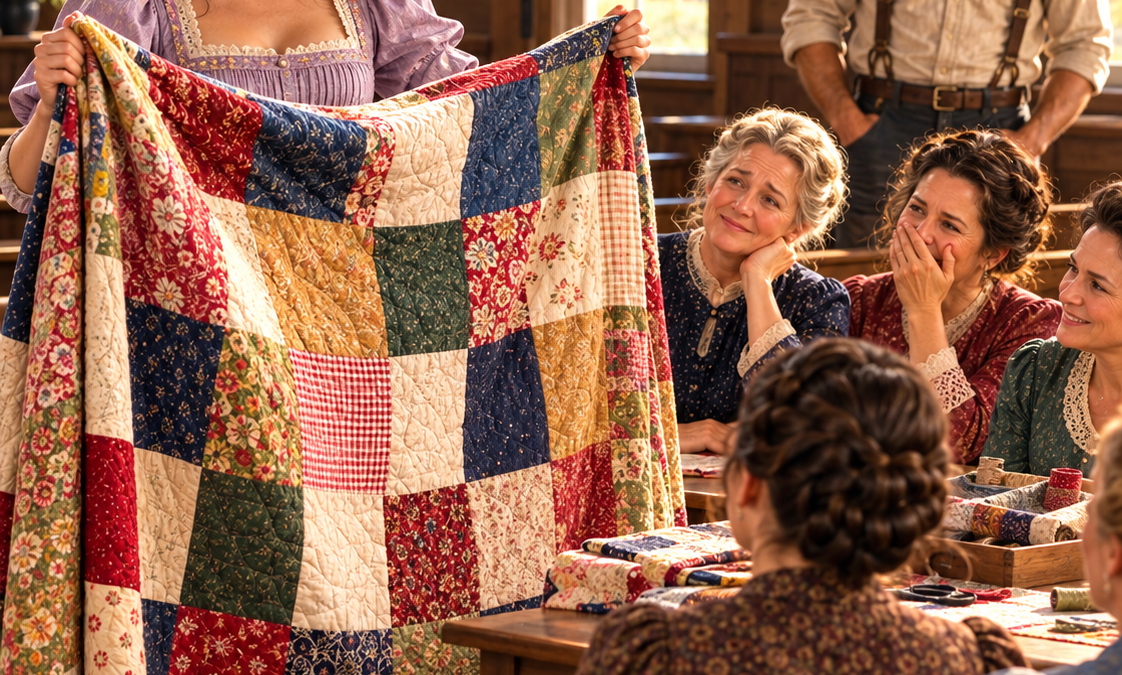
The sewing circle met on the second Tuesday of every month in the back room of the Methodist church. On this particular Tuesday in late October, the women of Harland County had laid out twelve finished squares on the long table to admire and adjust before the final assembly.
Netti Doyle arrived late, which was already a problem because late meant drawing attention. She had her square folded in her coat pocket—a six-inch piece of warm brick-colored broadcloth she had cut from an old skirt belonging to her mother, pieced with cream and sage.
She set it on the table. Nobody spoke for a beat too long.
“Oh, Netty…” That was Johanna Fletcher, who said things the way a schoolteacher circles a wrong answer. “We agreed on blue.”
The twelve squares on the table were blues and ivory with small bursts of pale yellow. Netti’s square was the color of dried leaves, of a woman’s old skirt, of brick on the south side of a building that had caught forty years of afternoon sun.
“I misunderstood,” Netty said, keeping her hands flat on the table. She hadn’t misunderstood at all.
“We could put it on a different project,” Johanna said. “It’s lovely work. It just doesn’t fit here.”
Netty folded her square and put it back in her coat pocket. She slipped out the church’s side door into the narrow alley.
A man was leaning against the fence at the alley’s end, reading a folded sale notice. He looked up when she came through. She recognized him by his hat: Gideon Stone, who bought cattle for a livestock firm in Lexington and came through Harland County three or four times a year. A quiet man, people said.
“Evening,” he said.
She said good evening and kept walking.
Gideon spoke again. “That was yours. The square. The different one.”
She stopped. When she turned around, his expression was steady and plain. “I came in to get my sister,” he said. “I could see through the door. Then you saw it get put back in a pocket.”
“I did,” he looked at the fence post. “It was the only one I noticed.”
That was worse than anything Johanna Fletcher had said. A compliment aimed wrong lands harder than criticism because you have to figure out what to do with it.
Three days later, a small bundle of fabric scraps appeared on her porch, tied with twine in a flat cattleman’s knot. There was no note—just four pieces of cloth: a dark wine-colored flannel, a strip of faded canvas, a piece of worn brown corduroy, and a bit of soft gray wool.
Using those scraps and contributions that followed from others, the community quilt evolved from a matching pattern into a rich record of personal histories. Yet, as Gideon continued to pass through town—bringing odd pieces of fabric the way other men brought flowers, fixing porch boards, and sharing quiet moments over coffee—the town’s whispers began to grow.
When the quilt was finally completed and hung on display in March, Netti’s original “wrong” square sat proudly right in the center, having found its way there through repeated returns.
And when Gideon finally spoke to the reverend to stay for good, bringing his solid presence to Netti’s home, the quilt on the sitting room wall caught the morning light—proving that some things don’t need to match the crowd to find where they truly belong.
Netti kept the square in her pocket all the way home. The alley had been cold enough to sting, and Gideon Stone’s voice had been worse than the cold, because it had been accurate. The only one I noticed. She did not know what a person was meant to do with accuracy from a man who bought cattle and left town.
Her house sat two streets off the square, a narrow place she had kept after her mother died: two rooms, a porch with a soft board, a garden that grew more sage than flowers. She hung her coat on the nail, took the square out, and spread it on the table under the lamp. Brick, cream, sage. The stitches were small. Her mother had taught her that a seam should not announce itself. Johanna Fletcher preferred seams that proved the stitcher had obeyed.
Netti did not unpick it. She folded it into the drawer where she kept buttons and went to bed angry, which was a cleaner feeling than shame and harder to sleep on.
In the morning the anger had cooled into work. She had hems for the mercantile and a stack of shirts from the boarding house, and she sat by the window where the light was honest. People passed. No one stopped. Harland County could ignore a woman efficiently when it had decided she had failed a small public test.
On the third evening she came up the steps with her thread basket and nearly put her foot on the bundle. Twine, flat, the knot neat as a fence tie. Four scraps and no name. She stood with the basket on her hip and looked down the street. Empty. A horse had passed recently; the dust still held the shape of it.
Inside, she untied the knot without cutting it, because the knot was part of the message and she was not ready to decide what the message was. Wine flannel, sun-faded. Canvas from a wagon sheet, the weave gone soft at the edge. Corduroy the color of a plowed field after rain. Gray wool that had been a cuff once, the buttonhole still in it. None of it was blue. None of it was ivory. All of it was cloth that had already belonged to a life.
She did not start a quilt. She put the scraps in the drawer beside the square and went back to the boarding-house shirts. If a man wanted to leave cloth on a porch, that was his business. If she made something of it, that would be hers, and she was not going to do it where Johanna could call it a misunderstanding.
Gideon Stone came through again on the Friday. She knew because the boarding house had an extra order and because Mrs. Ellison, who missed nothing that could be repeated, said the cattle buyer was at the stockyards and had asked after the Methodist social as if he cared about socials. Netti kept her head down over a cuff. In the afternoon a shadow fell across her porch boards, and when she opened the door he was on the step with his hat in his hands, not crowding the threshold.
“Miss Doyle.”
“Mr. Stone.”
“The scraps were mine. I should have said. A man at the yards had a torn coat. The canvas was off a cover I was done with. I thought—” He stopped, looked at the soft board, and seemed to choose a plainer road. “I thought you might want cloth that wasn’t voted on.”
“Most people bring a note,” she said.
“I don’t write notes that come out right.” He turned the hat once. “If it was unwelcome, say so. I’ll take them back and we can pretend I was only leaning on a fence.”
Netti studied him. He was older than the boys Johanna’s circle married, younger than the widowers who came to church to be fed. Dust on the boots, a mend on the sleeve done by someone in a hurry. Quiet, the town said. Quiet was a word people used when they had not been given a better one.
“They were not unwelcome,” she said. “They were unexplained. Those are different.”
“Then I’ll explain next time, if there is a next time.”
“There is cloth in the drawer,” she said. “I haven’t decided.”
He nodded as if that were a complete transaction. “Your porch board rocks. I can see it from the street. I have a hour before the train allotment. I can set a cleat under it, or I can leave it alone.”
She should have left it alone. The town would make a story out of a man with a hammer. She thought of Johanna circling a wrong answer, and of the alley, and of the fact that the board had rocked since February.
“The tools are in the apple crate,” she said. “Don’t talk to anyone who stops.”
No one stopped. He worked without commentary, reset the board, and tested it with his boot. When he finished he washed at the pump and dried his hands on his own handkerchief.
“It will hold,” he said. “Until it doesn’t. Wood moves.”
“So do towns,” she said, and then wished she had not, because it sounded like an invitation to a deeper talk than she had planned to have on a porch.
He only said, “Yes.” Then he put his hat on and walked back toward the yards, and the board under her foot did not rock.
The second bundle came a week later, left at dawn, with a pencil line on the inside of the canvas: From a shirt that wore out honest. Not a letter. A label. Netti sat with it in her lap a long while. Then she took out the brick square and the four first scraps and began, not a church quilt, a map. She pieced without a pattern drawn on paper. The wine flannel went beside the sage. The corduroy held a corner down. She worked in the evenings after the paid sewing was done, and she did not take it to the Methodist back room.
Word moved anyway. Mrs. Ellison saw the cloth on the line, drying after a sizing, and asked if Netti had given up the circle. Netti said the circle had a blue quilt to finish and did not need her brick. Mrs. Ellison made a sound that could have been sympathy or storage for later.
Johanna came on a Thursday with a paper of pins and a face arranged for kindness.
“We saved a place,” she said, standing in the doorway Netti had not opened all the way. “If you redo the square in the agreed cloth, it can still go in. No one wants you left out, Netty. It looks unfriendly.”
“I’m not left out,” Netti said. “I left. Those are different too.”
“People will think you’re proud.”
“People will think something. They already did, when I was on time and blue.” She heard the edge in her own voice and did not sand it down. “Thank you for the place. Give it to someone whose cloth matches.”
Johanna left the pins anyway, on the rail, which was a kind of small warfare. Netti brought them in so the rain would not take them and put them in the button drawer. Waste was a sin her mother had believed in more firmly than pride.
Gideon’s third visit was not a bundle. He knocked at dusk with a paper sack of coffee, the cheap kind the yards sold, and asked if he might sand the porch rail where a splinter had caught his palm. She put the coffee on the stove because refusing food and drink was a larger scene than accepting it. They drank it at the table with the piecing between them, unfinished, weighted with a saucer.
He looked at the brick square in the center of what she had begun and did not touch it.
“That’s the one from the church.”
“Yes.”
“It sits right there. Like it decided.”
“I decided,” she said. “Cloth doesn’t get opinions.”
“No,” he said. “But you can give it a job.” He turned the cup. “I’ll be back through before the cold sets hard. If you’ve thrown this out by then, I won’t mention it.”
“I don’t throw work out.”
“I noticed that.”
He left before the coffee was gone, which she respected, and she sat with the rest of it and the map of scraps and felt the house change size by an inch. Not larger. More occupied by the possibility of return.
November narrowed the light. The sewing circle finished its blue quilt and displayed it at the church supper, even and pale, a field of agreement. Netti went, because not going would have been a speech. She stood at the side with her gloves on and admired the stitches, which were good. Johanna accepted the admiration with the relief of a woman whose project had not been ruined by brick. Gideon was not in the county. His absence was its own kind of presence, a chair no one else knew was empty.
The scraps kept arriving by other hands once the first ones had been seen. Mrs. Pell’s hired girl brought a strip of calico from a dress that had not survived a washing-pot accident, and said her aunt had heard Netti was making a quilt that took what it was given. The blacksmith’s wife sent a square of soot-colored linen and a note that said, Use it or burn it, I am done looking at it. A child from the school left a handkerchief with a poor cross-stitch N on the step, and Netti pieced the N in where a corner needed weight. She did not ask the town for contributions. The town, bored of blue, brought them anyway. Some came from kindness. Some came from the pleasure of being included in a story Johanna did not control.
Netti took all of it. She refused only one piece: a length of ivory Johanna sent by way of Mrs. Ellison, with the suggestion that a border would “settle the colors.” Netti sent it back folded, unused, with thanks. Borders were for people who wanted the middle kept in.
Gideon returned in the second week of December with snow on his shoulders and a parcel of gray wool larger than the rest, cut from a blanket he said had gotten him through a bad night on the Lexington road. He did not offer it as a bouquet. He set it on the chair and asked after the porch board. It had held. She told him so. He looked pleased in a restrained way, as if the cleat had been a promise he was glad to have kept.
“May I see it?” he asked, meaning the quilt.
She spread it on the bed because the table was too small now. The brick square had stayed near the center by gravity more than plan. Around it the county had begun to show: wine, soot, calico, canvas, the child’s N, a bit of striped ticking from the doctor’s old apron. It was not harmonious. It was legible. A person could stand over it and know that more than one life had touched the cloth.
Gideon stood with his hands behind his back.
“It doesn’t match,” he said.
“No.”
“It looks like a place I’ve been.” He glanced at her. “That’s a compliment. I’ll take it back if it’s the wrong kind.”
“It is the right kind,” she said, and felt her face heat, which annoyed her. “Sit down. The coffee is from the sack you brought. I don’t waste that either.”
They talked until the lamp needed trimming. He told her, in pieces, that the livestock firm was tightening, that he was tired of trains, that his sister in the next county had a husband and did not need a brother appearing three times a year to be useful. He did not say he meant to stay. Netti did not ask him to. She told him the circle had finished its quilt and that she had gone to see it. He said he was sorry to have missed the alley door, then corrected himself.
“Not sorry you left. Sorry you had to.”
“I didn’t have to,” she said. “I could have recut the square. I have blue in the scrap bag. I chose the pocket.”
“I saw you choose it.”
The sentence sat between them like the brick cloth had sat on the church table. Netti looked at his hands, scarred across one knuckle, steady on the cup. She thought of her mother’s rule about seams. Some things should not announce themselves before they were strong enough to hold.
“If you come back after Christmas,” she said, “the rail by the steps is loose. That is not an invitation to a story. It is a loose rail.”
“I’ll bring a driver and a longer screw,” he said. “And I won’t talk to anyone who stops.”
He was as good as the sentence. Christmas passed quiet, with a ham from the boarding house in exchange for a season’s mending and no callers except Mrs. Ellison, who brought a pie and a report that Johanna had told the circle Netti was “doing something artistic,” which was Johanna for out of order. Netti ate the pie and did not supply a better phrase.
In January Gideon fixed the rail. In February he stayed three days at the boarding house instead of one, and the town began the whispers the way a quilt begins, one scrap at a time. He was seen at her pump. He was seen carrying a crate of thread from the mercantile. He was not seen doing anything that would have interested a preacher, which disappointed the whispers without stopping them. Netti kept the door open when he was inside and the curtain up, not because she felt guilty but because she refused to give Harland County a dim room to invent.
On the last night of that visit she walked him to the gate. The cold was a clean one. The quilt, basted now, waited on the bed.
“The firm wants me in Lexington through the spring sales,” he said. “After that they want a man in this county who already knows the herds. Permanent. A house if I take it. I haven’t answered.”
“Why tell me?”
“Because if I take it, I will be at your gate more than three times a year. That will finish the whispers or prove them. I won’t do that to you as a surprise.”
Netti put her hand on the post he had reset. The wood was cold and solid.
“Take the work if you want the work,” she said. “Don’t take it as a favor to a quilt. If you are here, you may call. If you call, I will decide each time whether the door opens. That is the matching I am willing to do.”
He was quiet long enough that she thought she had been too plain. Then he said, “That is the matching I wanted. I don’t do well with patterns I didn’t help cut.”
“Neither do I.”
In March the quilt was done. She had bound it in the brown corduroy, sturdy, nothing that pretended to be ivory. The brick square sat in the center because every added piece had made room for it instead of covering it. She hung it on the sitting-room wall on a morning when the light came in sideways and turned the sage almost gold. Then she did a thing she had not planned. She carried a second, smaller hanging to the church supper, pieced from the leftovers, and set it on the table beside the blue quilt without asking for a vote.
People gathered. Some frowned. Mrs. Pell’s girl smiled with her whole face. The blacksmith’s wife found her soot linen and nodded once, satisfied to be rid of it and also to see it matter. Johanna stood at the end of the table with her hands folded.
“It’s very busy,” Johanna said.
“It’s very inhabited,” Netti said.
Gideon was in the doorway, hat off, not crowding. He had spoken to the reverend that afternoon. Netti knew because the reverend had stopped her on the steps and said, carefully, that Mr. Stone had asked about renting the old Mercer rooms and about the rules of calling on a respectable woman, and that the reverend had told him the rules were the same as they had always been: daylight, open doors, and no one’s permission but hers. She had thanked him and gone in before her face could do anything public.
After the supper Gideon walked her home. He did not take her arm. At the porch he looked up at the window where the quilt’s edge showed, brick and cream and the child’s crooked N.
“It found the middle,” he said.
“I put it there.”
“I know.” He set a paper packet on the rail. Not cloth. Seeds, marked in his bad handwriting: sage. “For the garden. You don’t have to plant them.”
“I know that too.”
She planted them in April, on a day when he was at the yards counting another man’s cattle and the town had begun, slowly, to use his name without the phrase “that buyer.” The sage came up thin and gray-green and did not match the roses Mrs. Ellison grew for show. Netti let it. In the evenings Gideon sat on the repaired porch with coffee from his sack, and she sat with mending, and the quilt inside held the colors the circle had not wanted. Sometimes they talked. Sometimes they did not. The loose boards stayed fixed. The whispers thinned into something duller and more survivable: habit.
On a Sunday in May he asked, in the same voice he had used in the alley, whether she would object if he spoke to the reverend about a date. Not a sale notice. A wedding. Small, he said. No voted colors. She could wear what she already owned.
Netti looked at the sage, which had no business thriving in the spot she had given it, and at the man who had noticed the one square that did not fit.
“I would not object,” she said. “I would set conditions. The quilt stays on the wall. The door stays a door I open. And if anyone tells me the cloth ought to have been blue, they can sit with Johanna and admire the other one.”
“Those are good conditions,” Gideon said. “I can live inside them.”
“Then ask him,” she said.
He did. The date was set for June, in the front room of the church rather than the back, with no quilt committee and no agreement but theirs. Netti wore her mother’s altered dress, which was not ivory and not new, and carried no flowers except a sprig of the sage from the porch bed. Gideon wore the mended coat. The reverend kept it short. Mrs. Ellison cried in a useful way. Johanna attended and said the bride looked well, which was as close to a matching square as she was going to offer.
Afterward they walked to the narrow house. The porch board held. Inside, the quilt caught the morning-late light on the sitting-room wall, brick at the center, every wrong color doing the work it had been given. Gideon set his hat on the nail beside her coat. He did not reach for her as a man reaches for a purchase. He waited, the way he had waited in the alley, until she turned.
“Evening,” he said.
“Evening,” she said, and opened the drawer where the first scraps had been, empty now, the work already on the wall. “There is coffee. There is a rail that will need looking at in the fall. And there is nothing in this house that has to match, except that we both chose it.”
“I noticed,” he said.
This time the accuracy did not land hard. It landed where she had left room for it, in the center, beside the brick and the sage and the knot she had never cut. Outside, Harland County went on with its suppers and its votes. Inside, the seams held without announcing themselves, which was all her mother had ever asked of cloth, and more than Netti had expected of a life.
You Might Also Enjoy


A striking argument from prosecutors has become one of the final talking points in Russell Brand’s high-profile London trial