When the Bread Isn’t Ready: How a Cowboy’s Quiet Patience Built a Family on the Prairie
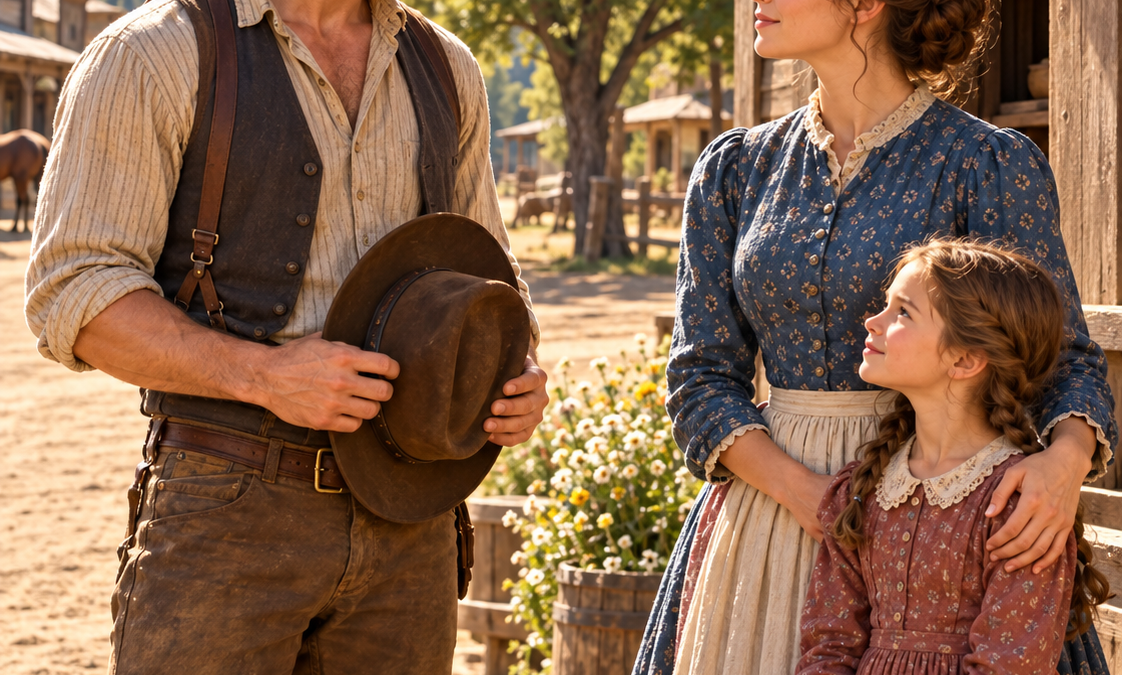
Ruth locked the bakehouse door, turned toward the quiet, weathered cowboy she had married only hours earlier, and asked the question she believed would finally expose what he expected from her. Luther Mercer actually stepped backward, his worn hands smoothing his hat once more. Then he confessed something Ruth never imagined hearing from a man who had spent years silently carrying the weight of a frontier ranch.
Only that morning, Ruth had arrived with her two children, a handful of battered baking pans, and what remained of a life built on relentless hard work.
At twenty-eight, she was already a góa phụ.
Her late husband had left little behind except memories and the crushing daily struggle to keep a roof over her children’s heads. When Luther—the quiet cowboy who had shown up at her bakery every Saturday for weeks—offered not just his name, but a shared home, a partnership, and a hand with her boy Jacob, marrying a local man seemed less daunting than facing the cold unknown alone.
His visits had been practical. He brought orders, counted loaves, and found small ways to help. But when Luther stepped into her world, she wondered if she was risking too much.
He was strong, silent, and steady. Yet he never demanded more than she was ready to give.
That evening, as the rain beat against the cabin roof, Ruth kept filling the silence by explaining her daily chores, the baking schedule, and how she could manage.
Finally, Luther put his coffee cup down. “You don’t have to earn your place here.” She frowned. “I didn’t bring you here just to keep house.” “You asked for a husband.” “Yes.” Her gaze accidentally moved toward the modest bed in the corner. Luther immediately looked away.
Later, while Ruth settled the children, her new husband became strangely busy with every conceivable chore. He checked the horse stalls, tightened a latch, and adjusted the firewood.
“Luther.” He froze. “The wood is fine. The barn is secure. And you don’t need to fix anything else tonight.” Slowly, he lowered his hands. “I can sleep out by the bakehouse.” Ruth stared at him. “We’re married.” “That doesn’t mean you owe me anything tonight.”
Those words frightened her more than a demand might have. “You gave my children a home,” she said carefully. “Gave me your name and your strength.” “I didn’t buy a family.” “Didn’t you?” “No.”
The absolute certainty in his voice silenced her. Luther admitted that what he wanted was painfully simple. After years of lonely ranch work and quiet evenings, he wanted another voice across the supper table. Another pair of footsteps in the yard. Someone to share the quiet rhythm of the plains.
Still, old memories whispered caution. So Ruth decided to test him.
She walked to the door. Click. The latch slid firmly into place. Luther’s eyes widened when she turned back to face him.
When she confronted him directly about what he truly expected from their marriage, the strong, silent cowboy’s face flushed red.
“I’ve never had a family of my own to care for,” he finally murmured, looking down at his boots. “Truth is… I was afraid I wouldn’t know how to be what you and the children need.”
Something inside Ruth softened completely. “Sit beside me.”
He obeyed, leaving such a respectful distance between them that she almost smiled. “You’re afraid of failing us.” “I’m afraid of letting you down.”
Ruth placed her hand over his rough fingers and felt them steady. “We’ll figure it out together.” “Always?” “Always.”
Outside, the Nebraska night stretched wide and calm. Inside, Ruth realized the quiet cowboy she had married was the first man she could truly trust with her whole heart.
Luther searched her eyes, swallowed nervously, and whispered: “Will you teach me how to be a husband?”
Ruth did not answer at once. The rain had softened to a steady ticking against the cabin roof, and the fire had settled into a low red bed of coals. Luther’s question hung between them, quieter than the latch she had just turned.
“Teach you,” she said at last.
“If you’ll have the patience for it.” His thumb moved once under her hand, then stopped, as if even that small motion might be too much. “I know horses. I know weather. I know how far a man can push a fence before the posts give. I don’t know this.”
“This,” she said, “is supper, and boots by the door, and not walking out when the children wake crying. It is not a trade you learn in a week.”
“I have the winter,” he said. “And the spring after that, if you’ll still want me then.”
She almost told him she had already decided. Instead she rose, crossed to the cupboard, and took down the tin where she kept the last of the sugar. “Then we begin with breakfast. Jacob will be up before the light. He always is. He checks the door the way his father used to, to see if the world is still there.”
Luther nodded as if she had handed him a set of orders he meant to follow exactly.
In the morning the world was still there, gray and wet, the yard pocked with standing water. Ruth woke to the smell of coffee already made and the sound of someone moving carefully, as if the floorboards might take offense. Luther stood at the stove in his shirtsleeves, watching the pot with the same concentration he gave a skittish mare. He had set three cups on the table and then, after a moment’s thought, a fourth, smaller one.
Jacob appeared in the doorway in his nightshirt, hair standing up, eyes wary. He was nine, old enough to remember a house that had gone quiet too suddenly, young enough to believe a locked door could keep trouble out. Behind him the little girl, four years old and still called Baby by everyone who loved her, though her name was Eliza, peered around his elbow.
“Morning,” Luther said. He did not step toward them. “Coffee’s on. There’s bread from last night if your mother allows it.”
Jacob looked at Ruth. She nodded. The boy came in, sat, and kept both hands on the table edge as if the chair might be taken back. Eliza climbed into Ruth’s lap without asking and stared at the strange man who had slept, Ruth realized only then, on a blanket by the hearth rather than in the bed.
“You fixed the latch,” Jacob said.
“It was loose,” Luther said.
“Pa used to fix things and then they broke again.”
“Sometimes they do,” Luther said. “Then you fix them again.”
Jacob considered this and ate his bread in small, exact bites. Eliza reached for Luther’s cup. Ruth caught her hand. Luther pushed the small cup forward, already cooled with a splash of milk he must have brought in from the springhouse before dawn. Eliza drank and left a mustache of milk on her upper lip. For the first time since Ruth had known him, Luther smiled without looking down.
That was the first lesson, though neither of them named it. He learned the shape of their mornings. Ruth learned that he would be awake before her and would not touch the baking pans unless asked. The bakehouse, a low stone room off the yard that had come with the claim, became hers by an understanding they never wrote down. He carried flour when the sacks were heavy. He did not comment on how she measured. On the third day he came in while she was scoring loaves and stood with his hat in his hands until she pointed at the bench.
“You can sit.”
“Didn’t want to be underfoot.”
“You’re not.” She slid a tray toward the oven. “My husband used to say a kitchen was no place for a man. Then he ate everything I set down and never once asked how it was made.”
“I’m not him,” Luther said.
“I know.”
He stayed. He watched the dough rise and asked one question, only one: whether the heat of the oven changed with the wind. She told him it did. He nodded and filed the fact away the way he filed the signs of a storm.
The children tested him the way children test a frozen pond, one careful step at a time. Jacob would not let him near the horses at first. The boy had a pony, a patient thing Luther had included in the marriage without announcing it, and he brushed that pony himself every evening with a seriousness that made Ruth’s throat tight. On the fifth night Luther oiled a bridle at the corral rail and did not offer to help. Jacob worked in silence. When he finished he said, “The bit was rubbing.”
“I saw,” Luther said. “You’ve a good eye.”
Jacob flushed and led the pony in. Later, through the cabin wall, Ruth heard him tell Eliza that the new man had not tried to take the brush. Eliza, who understood less and trusted faster, had already decided Luther was the person who knew where the barn cats hid their kittens. She brought him one, a damp gray scrap, and set it in his boot. He did not laugh. He cupped the kitten until Eliza was satisfied, then carried it back to the hay as if it were a task he had been given and meant to finish properly.
At night he still slept by the hearth.
Ruth let him. She told herself it was for the children, who needed the sight of her in the bed alone a little longer. She knew it was also for herself. Marriage had been a door she walked through because the other side of it held a roof. She had not expected the man on that side to ask permission to learn her. The asking unsettled her more than a claim would have. A claim she could refuse. Patience asked something back.
On the tenth evening the rain returned, harder, and the road into town glazed with mud. No one would come for bread. Ruth banked the oven early and found Luther in the barn, resetting a hinge the wind had worried loose. His shirt was damp across the shoulders. When he turned, the lantern threw the lines at the corners of his eyes into relief. He was thirty-four. She had asked the preacher. He looked older when he was tired and younger when Eliza fell asleep against his knee, which had happened once, by accident, while he mended a tear in Jacob’s coat.
“Come inside,” she said.
“In a minute.”
“The hinge will keep.”
He followed her. The children were already in the trundle, Jacob pretending to read by the last of the light, Eliza asleep with one foot uncovered. Ruth covered the foot. She poured two cups and set them on the table and did not sit until he did.
“You’ve been sleeping on the floor,” she said.
“It’s a good floor.”
“It’s a foolish floor, in October, with a bed in the room.”
He turned the cup but did not drink. “I didn’t want you waking up and thinking you had to—” He stopped. The flush rose again, the same one she had seen when she locked the bakehouse door. “I meant what I said. You don’t owe me the bed. Or anything that happens in it.”
“And if I am not paying a debt,” she said, “what am I doing if I ask you to sleep where a husband sleeps?”
He was quiet so long she thought she had pushed too far. Then he said, “Hoping. I think. I’d be hoping.”
She reached across and put her hand on his wrist, the way she had the first night. The pulse there was quick. “Then hope on the bed. The floor is for dogs and men who are still deciding whether they’re allowed to stay.”
He looked at her as if she had offered him something breakable. “All right.”
That night he lay on top of the quilt in his shirt and trousers, straight as a fence post, and Ruth lay under it in her nightdress with a careful hand’s breadth between them. She listened to him breathe. Once, near midnight, Jacob cried out from a dream and Luther was on his feet before she was, already at the trundle, one palm on the boy’s back, voice low. “You’re here. The door’s shut. You’re here.” Jacob subsided without waking fully. Luther stood a moment longer, then came back and lay down in the same straight line. Ruth turned onto her side, facing him. In the dark she found his hand and set it, deliberately, against her waist over the quilt. He did not move it. After a while his fingers curled, lightly, as if he were holding a rein he was afraid to tighten.
She slept.
Word moved through the county the way word always moved, by way of the mercantile and the Sunday wagon and the woman who bought six loaves every Friday for the boarding house. Ruth Mercer, they said, had married the quiet Mercer who ran cattle on the old Hayes section and never came to dances. Some said she had done well. Some said he had. A few said nothing and watched, which was worse. On the second Sunday Luther hitched the wagon without being asked and waited while she tied the children’s collars. He had shaved. The cut on his jaw was small and precise.
“You don’t have to come in,” she said. “The preacher married us in the parlor. No one expects a show.”
“They’ll look anyway,” he said. “Better they look at me standing next to you than at an empty place.”
They looked. Ruth kept her eyes on the hymnbook. Jacob stood between them and did not hold either hand, but when the congregation sat he shifted half a step closer to Luther’s boot, and Luther did not move his foot away. Afterward, on the church steps, Mrs. Peyton from the boarding house touched Ruth’s sleeve.
“He’s a steady one,” she said, not unkindly. “My cousin knew his mother. She died when he was small. The father drank. The boy raised himself on that section after the old man went under the ice. You won’t get speeches from him.”
“I didn’t marry him for speeches,” Ruth said.
Mrs. Peyton smiled with half her mouth. “Then you may be the first woman in this county with any sense.”
On the ride home Eliza fell asleep against Luther’s coat. He drove one-handed so as not to shift her. The sky had cleared into a hard blue, the kind of October day that pretended winter was a rumor. Ruth watched the road and the man and the sleeping child and felt something loosen in her chest that had been tight since the morning she buried her first husband and understood the bakery would not bake itself.
“Your mother,” she said.
“I don’t remember her face,” he said. “I remember she hummed when she mended. That’s all. The rest is what people tell me.”
“And your father.”
“He was a mean drunk and a worse rancher. I sold what he left and bought the Hayes place with the money and seven years of wages. I didn’t keep his name out of sentiment.” He glanced at her. “I kept it so I’d have to answer to it. So I couldn’t pretend I came from nowhere.”
She understood that. She had kept her baking pans for the same reason. They were dented and one of them was missing a corner, and they were the proof that she had been someone before she was a widow.
The first real cold came on a Tuesday. Ruth woke to frost on the inside of the window and Luther already gone, the bed warm where he had been. She found him behind the barn with a yearling that had tangled itself in a downed wire. Blood on the snow, not much. His hands were red to the wrist. Jacob stood at a distance, holding the horse Luther had ridden out, face pale.
“He wouldn’t let me close,” the boy said when Ruth reached him.
“Good,” she said, and meant it. She sent him for hot water and clean cloth and went to Luther’s side. The yearling was quiet now, shocked past struggling. Luther’s voice, when he spoke to it, was the same voice he had used on Jacob in the dark.
“Almost,” he said to Ruth, not looking up. “Wire under the foreleg. If I’d waited she’d have sawed it to the bone.”
“You didn’t wait.”
“No.”
They worked. She had dressed worse things in a bakery when a knife slipped, and on a child when fever burned. This was not different in the way that mattered. When it was done Luther walked the yearling slow circles until the leg bore weight, then turned her into the near paddock. He washed at the trough until the water ran clear. His hands shook, finely, the way hands shake after they have been needed.
Jacob had not gone back to the house. “Is she going to die?”
“Not of that,” Luther said. “She’ll scar. Scars pull, sometimes, when the weather changes. You’ll see her favor it on wet mornings. That’s all.”
The boy absorbed this. “Can I watch her?”
“From the rail. Don’t climb in until I say.”
Jacob climbed the rail and stayed there through dinner. Ruth brought both of them bread and cold meat and did not tell the boy to come down. In the evening Luther showed him how to look at a healing wound without touching it, how to count the heat in a leg with the back of his fingers. Ruth watched from the doorway and thought: this is the thing I could not give them. Not the ranch. The noticing.
November narrowed the days. The bakehouse held its heat better than the cabin, and Ruth moved the children’s lessons there in the afternoons, such lessons as she could manage between loaves. Jacob wrote his letters on the back of flour sacks. Eliza arranged pebbles in rows and called it counting. Luther came in to warm his hands and stayed to hear the letters. He could read. He could write a plain hand. He had taught himself from a battered almanac and the labels on feed sacks, and he was ashamed of it until Ruth set a sack in front of him and said, “Then write the week’s order. My writing looks like a chicken walked through it.”
He wrote. His letters were square and careful. Jacob watched and copied the shape of the L until his own looked less like a hook. It was a small thing. Ruth put it away with the other small things: the way Luther checked Eliza’s shoes for stones, the way he never took the last piece of bread, the way he had begun, without announcement, to sleep under the quilt rather than on it, still careful, still waiting.
The quarrel came over salt.
A homesteader from the east section, a man named Burr who had bought two of Ruth’s pies at the church supper and considered this an acquaintance, stopped Luther on the road and offered a price for the north pasture that was insulting if you knew land and tempting if you knew winters. Luther refused. Burr rode on to the cabin anyway and made the same offer to Ruth while she was wrapping loaves, speaking to her as if the name on the claim were a detail.
“Your husband said no,” Ruth said.
“Husbands say no when they haven’t asked their wives what a bad year costs,” Burr said. He had a smile he thought was reasonable. “You’ve got children. A bakery doesn’t feed a family if the road closes.”
“The road has closed before,” she said. “We ate bread. Good day, Mr. Burr.”
He left angry. Luther came in an hour later, mud to the knees, and heard it from Jacob, who had been on the steps and had heard every word.
“You should have called me,” Luther said.
“You had already answered him.”
“He came to the house.”
“And he left it.” She set the peel down harder than she meant to. “I have been spoken to that way before. I do not need a man in the doorway to remember I can close a door.”
“I’m not saying you can’t.” His voice was low, which with him was worse than shouting. “I’m saying he came because he thought the marriage was a technicality. I won’t have that.”
“Then don’t have it in my bakehouse while I’m working.”
They stood on opposite sides of the table. The children had gone very quiet in the cabin. Ruth saw Luther hear that quiet and hated, briefly, that he was right to hear it. She also saw him swallow whatever he had meant to say next.
“I’ll speak to him on the road tomorrow,” he said. “Not here.”
“Speak to him however you like. Don’t speak for me.”
“All right.”
He went out to the barn and did not come in for supper. Ruth fed the children and told them the truth in the size they could hold: that adults disagreed, that no one was leaving, that the bread would still be there in the morning. Jacob nodded too quickly. Eliza cried because Jacob’s face had changed, not because she understood. After they slept Ruth banked the fire and sat in Luther’s chair, which was how she thought of it now, and waited.
He came in near nine, smelling of cold and hay. He hung his coat. He looked at the plate she had kept warm on the hearth and then at her.
“I was wrong about the doorway,” he said. “You didn’t need me for Burr. I needed to be the one who stood there, and that’s not the same thing.”
She had prepared a longer argument. It fell apart at the admission. “Sit down and eat.”
He sat. Halfway through the plate he said, “If he comes again, I still want to know. Not so I can answer for you. So I know who to keep off the north fence.”
“I’ll tell you.”
“Thank you.”
She almost laughed. “You’re welcome. Eat.”
Later, in the dark, she turned to him and fitted her forehead against his shoulder. He went still, then breathed out. “Are we all right?”
“We’re learning,” she said. “That was the lesson. You don’t get to pass it once.”
His hand found her hair and rested there, cautious. “I’ll take it again if I have to.”
“You will,” she said, and slept against him without the hand’s breadth between them.
December brought a sickness through the section, a cough that settled in the chest and stayed. Eliza took it first. Then Jacob. Then, because he would not stop going out to break ice on the troughs, Luther. Ruth moved through the cabin in a fog of kettles and mustard plasters and the particular fear that belongs to a woman who has already watched one life go out of a body and knows the signs. Luther’s fever broke on the third night. Jacob’s broke on the fourth. Eliza’s lingered, small and hot, and on the fifth evening Ruth came apart in the bakehouse where the children could not hear her.
Luther found her there. He was weak enough that he held the doorframe. He did not tell her it would be well. He sat on the bench and opened his arm and she went into it and shook until the shake wore itself out.
“I can’t lose her,” she said into his shirt. “I can’t. I already know how. I know exactly how the room gets quiet.”
“I know,” he said. He didn’t. He knew a different quiet, the quiet of a man under ice and a boy alone with a claim. It was close enough that she let him say it. “We’re here. The fire’s up. I’m not riding out.”
Eliza’s fever broke near dawn. She woke irritable and hungry and furious that no one would let her hold the gray kitten. Ruth cried again, in the pantry this time, silently, while she cut bread into the small squares Eliza would actually eat. When she came out Luther was in the chair with the child on his lap, both of them examining a piece of string as if it contained instructions. He looked up. His face was thinner. The cut on his jaw from Sunday had healed into a pale line.
“She wants the kitten,” he said.
“Tomorrow,” Ruth said. “If she eats.”
“I told her tomorrow.”
Eliza regarded her mother with the indignation of the recently rescued. “He promised.”
“Then it will be tomorrow,” Ruth said.
On Christmas morning there was no church. The road had drifted. Luther brought in a small pine, more branch than tree, and set it in a bucket of stones. Ruth tied flour-sack ribbons on it. Jacob, still pale, carved a star from a shingle and would not say where he had learned the cuts. Eliza, allowed the kitten for an hour under strict law, fell asleep with it in her lap and woke convinced the tree had grown there by itself. They ate roast hen and bread with the last of the summer preserves. In the evening Luther put a paper parcel at Ruth’s place. Inside was a new baking pan, tin, unbattered, the corner whole.
“The mercantile had it in October,” he said. “I didn’t know if it was a thing you wanted or a thing that would feel like I was replacing what you brought.”
She turned the pan in her hands. The metal was cold and bright. “Both,” she said. “I want it. And I am keeping the old ones.”
“Good.”
She had nothing wrapped for him. She had not known what a man like that would take without feeling bought. So she gave him the thing she had been saving since the night she locked the door. She sent the children to the trundle with an extra blanket and the solemn charge of watching the kitten. She banked the fire. She stood in front of him in the cabin’s only good light and untied her apron, then the tape at her throat.
“Ruth,” he said.
“I’m not paying for the pan,” she said. “Or the roof. Or the way you sat with her. I am asking. Will you come to bed with me as my husband, and not as a guest who is afraid of the furniture?”
He stood. His hands hovered, then settled on her arms, and she felt the tremor in them and loved him for it with a suddenness that startled her. “You’ll tell me if I do it wrong.”
“I’ll tell you,” she said. “That was always the bargain.”
What followed was not graceful. He was careful to the point of apology, and she was shy in a way she had not expected to be, having been a wife before. The bed was narrow. An elbow caught the wall. Somewhere in it she laughed, and he laughed into her hair, surprised by the sound, and the surprise undid more of his fear than any instruction could have. She guided his hand. He learned the way he learned everything, by attention, by repeating what worked, by stopping when she went still. Afterward he did not roll away. He lay with his face against her shoulder and his palm over her ribs, counting, she thought, the proof that she was there.
“Was that all right?” he asked.
“It was a beginning,” she said. “Beginnings are supposed to be clumsy. We’ll get the rest by practice.”
“All right,” he said, and the word shook a little. “All right.”
Winter held. They practiced. Not only that—though that, too, in the early dark before the children woke, and sometimes in the afternoon when the bakehouse door was latched and the excuse was a delivery that did not exist. They practiced the rest of it. He learned that she went quiet when she was angry and loud when she was afraid, which was the reverse of what he had assumed. She learned that his silence was not absence; it was the place he went to choose his words, and if she waited he would bring them back. Jacob learned that a man could be asked for help with a sum and would not laugh at a wrong answer. Eliza learned that promises about kittens were kept.
In February the thaw came early and false, then winter slammed back and took three head of cattle that had wandered into a draw. Luther rode the line until his lips cracked. He did not say they could not afford the loss. Ruth did the figures herself, at the table, and turned the paper so he could see them.
“We can,” she said. “If I take the boarding-house contract through spring. Mrs. Peyton asked again.”
“That’s six loaves a day and pies on Sunday. You’ll be up in the dark.”
“I’m already up in the dark.”
He studied the paper. “Then I’ll do the morning milking and the first feed. You don’t come to the barn unless you want to.”
“I want to on Sundays,” she said. “So you remember I live here too.”
He nodded, and the nod was a whole conversation.
Spring arrived the way it arrives on the plains, not as a kindness but as mud and wind and a sudden green so sharp it looked invented. The road opened. Burr did not come back; someone in town said he had sold his own place and gone farther west, chased by a debt or a rumor. Ruth did not ask which. She had loaves to score. On the first warm Saturday Jacob rode the pony to the near fence without being told he could, and Luther watched from the barn and did not call him back. Eliza found the first flower, a stupid purple thing growing out of a cow path, and brought it to Ruth in a fist so tight the stem was crushed. Ruth put it in the new pan, which was an absurd use of a pan, and left it on the table where Luther would see it when he came in.
He saw it. He washed. He sat. He looked at the flower and at his wife and at the two children who were arguing, mildly, over whose turn it was to set the cups.
“I still don’t know if I’m doing it right,” he said.
Ruth set a loaf between them, split and steaming. “You came in,” she said. “You washed. You’re staying for supper. That’s the part no one could teach you. The rest we can keep learning.”
Outside, the Nebraska evening stretched wide, no longer quite calm, already full of insects and distance and the lowing of cattle that had survived the winter. Inside, the latch on the cabin door was undone, because no one needed it shut. Luther reached for the bread. Ruth watched his hand, scarred across the knuckles from the yearling’s wire, steady now, and thought of the question he had asked her in the rain, months ago, when he still believed he might be sent to the bakehouse to sleep.
He had asked her to teach him how to be a husband.
She had not known, then, that he would teach her something back: that a life built the second time could be chosen every morning, in coffee and hinges and fever-watches and clumsy tenderness, and that choosing it did not erase the life before. It only made room beside it. Jacob laughed at something Eliza said. The flower drooped over the rim of the bright pan. Luther looked up, met her eyes, and smiled the small smile he saved for the inside of the house.
“Always?” he said, echoing a word she had given him when the marriage was only hours old.
Ruth put her hand over his, over the scar, over the bread.
“Always,” she said. “Eat before it cools.”
You Might Also Enjoy


A striking argument from prosecutors has become one of the final talking points in Russell Brand’s high-profile London trial